How Long Does Saffron Take to Work?

The first week is too early to judge saffron. How long does saffron take to work? In the clinical trials that checked earliest, sleep quality pulled ahead of placebo by week 3 and mood by week 4, and several mood trials reported their main result at 8 to 12 weeks. A single dose has also shown a measurable effect on the same day in a lab stress test, though that's a different thing from the steady change people take saffron for.
Give it 6 to 8 weeks of consistent daily use, taken at the same time each day and at the dose on your product's label, before you decide whether it's doing anything for you. Here's the timeline the research supports, week by week.
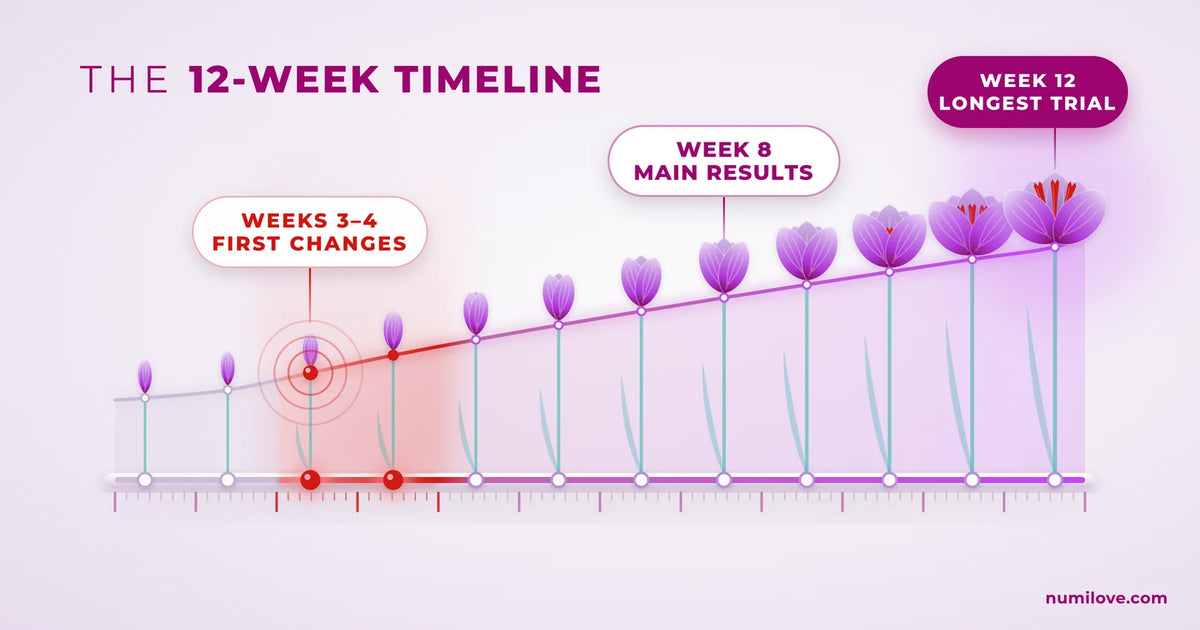
The saffron timeline, from first dose to 12 weeks
| When | What a trial measured | Study |
|---|---|---|
| One dose | A single 30 mg dose, taken 13 minutes before a lab stress test, lowered self-rated stress and anxiety in 19 young men | Pouchieu, 2023 |
| Week 3 | Sleep quality in the saffron groups pulled ahead of placebo and stayed ahead at week 4 | Schuster, 2025 |
| Week 4 | Mood scores improved at 28 mg a day in adults with low mood | Kell, 2017 |
| Day 28 | Mood differences from placebo were significant at Day 28 and held through Day 56 | Shah, 2026 |
| Week 8 | Youth-rated mood and anxiety symptoms improved | Lopresti, 2018 |
| Week 12 | Mood scores improved in 202 adults with low mood | Lopresti, 2025 |
Sleep moves first. In the 2025 trial that tracked it week by week, the saffron groups were sleeping better than the placebo group by week 3, which is earlier than any mood trial here reported a difference, although that gap partly reflects when each kind of study chose to measure. None of the mood trials here reported a result before week 4, so nobody knows yet whether mood shifts earlier.
How long does saffron take to work for sleep?
About 3 to 4 weeks in the trials. In a 2025 trial, 165 adults with moderate insomnia took 20 or 30 mg of Safr'Inside™ saffron extract a day for 4 weeks. By week 3, sleep quality in both saffron groups had pulled ahead of placebo, and it stayed ahead at week 4 (Schuster, 2025). An affron trial in 120 adults with poor sleep also reported better sleep quality after 28 days of a dose taken an hour before bed (Lopresti, 2021).
How long does saffron take to work for mood?
The first measured improvements came at week 4, and the trials here ran 4 to 12 weeks. Kell and colleagues found better mood scores at 4 weeks on 28 mg a day, the only time point they checked. The longest recent trial, 202 adults taking 28 mg a day, reported its result at 12 weeks.
What about focus and attention?
The research on attention is smaller and newer. Our review of saffron and ADHD research walks through all 4 published studies, the doses they used, and how long each one ran.
How to tell if saffron is working for you
Trials don't rely on memory, and you shouldn't either. They score mood or sleep with short questionnaires at fixed points. You can do a simple version:
- Before your first dose, rate your mood, stress and sleep from 1 to 10.
- Take saffron at the same time every day.
- Rate the same 3 things once a week, on the same day.
- Compare week 6 or 8 with your starting numbers.
Three things make a fair test more likely. Take the dose on your product's label, since each trial's dose belongs to the extract it tested. Don't skip days. And make sure the capsule holds real saffron.
Results depend on the capsule holding real saffron
No timeline applies to a capsule of safflower. Before you start your 6 weeks, check that your product publishes a lab report for its lot with an identity test.
Saffron360's lab reports are published by lot. Look up the lot number printed on your bottle to read its report: FTIR identity confirming Crocus sativus, plus heavy metals and microbiology, all passing, from an independent, ISO/IEC 17025 accredited laboratory. For dose and timing, read how to take saffron. To compare products, see our 2027 saffron supplement buyer's guide.
Frequently asked questions
Does saffron work immediately?
One lab study found a single 30 mg dose, taken 13 minutes before a stress test, reduced self-rated stress and anxiety. The changes people take saffron for, in mood and sleep, were measured after 3 to 12 weeks of daily use.
How long does it take for saffron extract to work?
In the trials that checked earliest, the first differences from placebo came at 3 to 4 weeks. Several reported their main results at 8 to 12 weeks of daily use.
How long does saffron take to work for sleep?
About 3 weeks in a 2025 trial of 165 adults, where saffron taken daily pulled ahead of placebo on sleep quality at week 3 and stayed ahead at week 4.
How long does saffron take to work for mood?
The earliest measured improvement was at 4 weeks, on 28 mg a day. The mood trials here ran 4 to 12 weeks.
What if I don't notice anything after 8 weeks?
Check 3 things: that you're taking the dose on your label, that you took it every day, and that your product's lot report confirms it's saffron. If all 3 check out, talk to your healthcare provider about whether to continue.
Do I need to keep taking saffron for it to keep working?
Trials measured results during daily use, for up to 12 weeks in the recent mood trials. None of the trials in this guide reported what happened after people stopped, so there's no data on how long effects last.
*These statements have not been evaluated by the Food and Drug Administration. This product is not intended to diagnose, treat, cure, or prevent any disease. This article is general information, not medical advice. Talk to your healthcare provider before starting any supplement, particularly if you are pregnant, nursing, managing a medical condition, or taking medication.
Curious how this shows up for you? Take the Dopamine Renewal Quiz. Eight questions, two minutes, and it names your Renewal Style.