Certificate of analysis
Saffron360 certificate of analysis
Lots now shipping SAF250514 and SAF250523 · Updated October 2026
These certificates authenticate real saffron (Crocus sativus) and screen it for what should not be there.
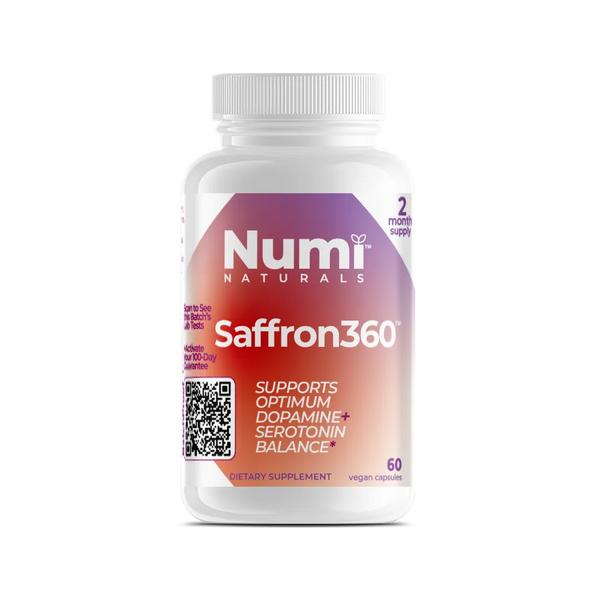
This page is our transcription of the certificates. It is not the certificates themselves. Every figure below is copied from the reports issued by Ethos Analytics Laboratory. The complete unaltered documents are linked underneath, and they are the record.
The certificates state that reports may not be reproduced with alterations of any kind, so we publish each one whole rather than cropping or restyling it.
What does the Saffron360 certificate for lot SAF250514 show?
Lot SAF250514 tested as genuine Crocus sativus and passed every heavy metal and microbiological screen. Ethos Analytics Laboratory (ISO/IEC 17025 accreditation 117798) received this powder sample, ID 25EA0522-002, on 23 May 2025 and completed testing on 27 May 2025. The FTIR result reads ID confirmed: the sample has the characteristics of the saffron standard. Lead measured 0.031 ppm against a 0.010 ppm limit of quantification, a pass, and the other 3 metals stayed below that limit. All 7 microbiological screens passed, from total aerobic count to Salmonella.
Saffron360 lot SAF250514 certificate of analysis (PDF)
Is Saffron360 lot SAF250523 real saffron, and did it pass heavy metals?
Yes. Lot SAF250523 is genuine Crocus sativus by FTIR, and all 4 heavy metals came back below the 0.010 ppm limit of quantification. Ethos Analytics Laboratory tested this lot too: sample ID 25EA0530-006, received 2 June 2025, testing completed 6 June 2025. All 7 microbiological screens passed.
Saffron360 lot SAF250523 certificate of analysis (PDF)
The laboratory didn't test every capsule; it tested a powder sample from each lot. Your bottle's lot number is printed on the bottom: if it reads SAF250514 or SAF250523, your bottle is from that same lot, and the matching certificate above is the one for your batch.
Sample and lot
Saffron360 is shipping from two lots, so this page carries both certificates side by side. Find the lot number printed on the bottom of your bottle, and the column headed with that number is the report for your batch.
| Field | Lot SAF250514 | Lot SAF250523 |
|---|---|---|
| Product | Saffron360 | Saffron360 |
| Certificate issued to | Vox Nutrition, the contract manufacturer that produces this formula | |
| Lot number | SAF250514 | SAF250523 |
| Sample name on the certificate | 13051 - Saffron 88.5 | 13051 - Saffron 88.5 |
| Laboratory sample ID | 25EA0522-002 | 25EA0530-006 |
| Sample type | Powder | Powder |
| Date received | 23 May 2025 | 2 June 2025 |
| Date completed | 27 May 2025 | 6 June 2025 |
| Serving size | Not specified on either certificate | |
| Full certificate | Open | Open |
What was tested?
| Analysis | Method | Tested, SAF250514 | Tested, SAF250523 | Status, both lots |
|---|---|---|---|---|
| Identity | FTIR | 27 May 2025 | 6 June 2025 | Complete |
| Heavy metals | ICP-MS | 26 May 2025 | 5 June 2025 | Pass |
| Microbiological | Petrifilm/qPCR | 27 May 2025 | 6 June 2025 | Pass |
Is this really saffron?
Yes, in both lots. Each certificate records ID Confirmed, which means the FTIR identity test compared that lot against a reference standard for Crocus sativus and found it matched.
| Analyte | Lot | Result | Specification |
|---|---|---|---|
| Saffron | SAF250514 | ID Confirmed. Test sample has characteristics of the standard | ID (Presence) |
| Saffron | SAF250523 | ID Confirmed. Test sample has characteristics of the standard | ID (Presence) |
The FTIR identity test reports presence, not quantity. No dose figure appears on either certificate.
How did it do on heavy metals?
Both lots passed. In lot SAF250523, arsenic, cadmium, lead and mercury all came back below the limit of quantification, so the ICP-MS method could not measure any of them. In lot SAF250514, arsenic, cadmium and mercury came back below that limit, and lead was measured at 0.031 ppm, which the certificate marks as a pass.
| Analyte | SAF250514 (ppm) | SAF250523 (ppm) | LOQ (ppm) | Limit (mcg/day) | Result, both lots |
|---|---|---|---|---|---|
| Arsenic | <LOQ | <LOQ | 0.010 | 15 | Pass |
| Cadmium | <LOQ | <LOQ | 0.010 | 5 | Pass |
| Lead | 0.031 | <LOQ | 0.010 | 5 | Pass |
| Mercury | <LOQ | <LOQ | 0.010 | 15 | Pass |
LOQ is the limit of quantification, the lowest concentration the method can reliably measure. A result below it means the analyte was not detected at a measurable level. A figure above it, such as the lead result for lot SAF250514, is the concentration the laboratory measured.
How did it do on microbiology?
Everything passed, in both lots. Each organism screened came in at or under its limit, and E. coli, Salmonella and S. aureus were not detected in either lot.
| Organism | SAF250514 | SAF250523 | Limit |
|---|---|---|---|
| Total aerobic plate | <20 CFU/g | <20 CFU/g | <100,000 CFU/g |
| Coliform | <20 CFU/g | <20 CFU/g | <100 CFU/g |
| Escherichia coli | Negative/10g | Negative/10g | Negative/10g |
| Salmonella | Negative/10g | Negative/10g | Negative/10g |
| Staphylococcus aureus | Negative/10g | Negative/10g | Negative/10g |
| Yeast | <20 CFU/g | <20 CFU/g | <1,000 CFU/g |
| Mold | <20 CFU/g | <20 CFU/g | <1,000 CFU/g |
Both certificates also record that the sample was inspected and found free from visual mold, mildew and foreign matter.
Who did the testing?
| Laboratory | Ethos Analytics Laboratory |
| Address | 3020 E Camelback Rd STE 397, Phoenix, AZ 85016 |
| Laboratory director | Noel Samsum |
| ISO/IEC 17025 accreditation number | 117798 |
| Licence number | 000026LRCND60176649 |
| Standards statement | Testing procedures, equipment calibration and maintenance are carried out to ISO/IEC 17025:2017 standards |
Both lots were tested by the same independent, ISO/IEC 17025 accredited laboratory, accreditation number 117798.
What these certificates do and do not establish
What it establishes
- The material is genuine saffron. The FTIR identity test compares each sample against a reference standard, and both lots matched it.
- Both lots passed every contaminant screen. All 8 heavy metal results and all 14 microbiological results are marked pass, and each measured figure is in the tables above.
What it does not
- Neither certificate quantifies the 88.5mg of saffron extract in a serving. These are identity and purity certificates, and no dose figure appears on either.
- It says nothing about what saffron does for anyone. That is a question for clinical research, not a laboratory certificate.
Numi Naturals
Saffron360
Third-party tested, with both certificates above published in full.
$32.00
Added to your cart. View cart
Check your own bottle
The lot number is printed on the bottom of your bottle. If it ends in a hyphen and more digits, the part before the hyphen is the lot. If it reads SAF250514, your bottle is from the same lot as the SAF250514 certificate above. If it reads SAF250523, it is from the same lot as the SAF250523 certificate.
Both lots are shipping now. If your bottle shows a different number, it is from a batch not listed here, and you can request that batch's certificate at hello@numilove.com or scan the code on the bottle.
Every published lot for every Numi Naturals product is listed in one table in the third-party lab results archive, with the laboratory, the method, the analyte, the measured result and the specification for each batch.
Get told when a new lot posts
This page carries every lot we are shipping now. When a new batch is tested, we add its figures here. Leave your email and we will send one message per new Saffron360 lot.
A laboratory issues its report to whoever submits the sample, so these certificates carry the name of Vox Nutrition, the contract manufacturer that produces our formulas. Each one names its lot, and that lot number is printed on every bottle from that batch.
They commission each lot's certificate from a laboratory owned by neither company, which is what makes it an independent check rather than a self-assessment.
Almost every supplement on the shelf is made by a contract manufacturer. The difference is that most brands do not tell you which one. JT Root explains how to find a supplement lot's lab report, from any brand, in a column for New Hope.